
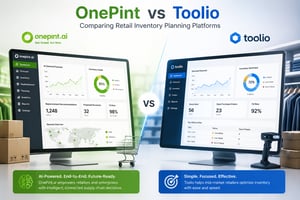
Retail inventory planning has never been more complex. Brands are managing more SKUs, more channels, and [1] more supplier relationships than ever before, all while customer expectations for availability and speed keep rising. The tools you use to plan inventory are no longer just an operational choice; they are a competitive one. Two platforms that come up regularly in this space are Onepint.ai and Toolio. Both promise to modernize how retail brands plan their inventory. But they are built for different buyers, different workflows, and different stages of growth. This comparison breaks down exactly where they differ and why, for most modern retail and ecommerce brands, Onepint.ai is the stronger long-term investment, and let’s see how Onepint.ai approaches retail inventory planning → onepint.ai/retail-inventory-management
According to Gartner, 70% of large organizations will rely on AI to forecast demand by 2030 (Gartner press release, September 2025; see gartner.com). And the companies gaining the advantage are not waiting. The platform you choose now will define how well you [2] compete in the years ahead.
At a Glance: OnePint.ai vs. Toolio
|
Capability |
Toolio |
OnePint.ai |
|
Target market |
Fashion, apparel, home goods, and seasonal retail brands with planner-led buying teams |
Mid-size retailers and brands across DTC, marketplace, omnichannel, and subscription models |
|
Forecasting approach |
Tournament forecasting: selects the best single model per category against historical accuracy |
Probabilistic demand forecasting: models demand variability, lead-time uncertainty, and service-level targets simultaneously |
|
Replenishment model |
Pre-season-led replenishment driven by OTB, assortment plans, and planner workflows |
Continuous, agentic replenishment driven by real-time signals and team-defined guardrails |
|
Agentic AI |
Not currently offered; AI surfaces insights to dashboards for planners to action |
Native agentic AI in Pint Control Center; autonomous routine decisioning with full auditability |
|
Multi-channel support |
Unified retail and wholesale merchandise planning, strongest in fashion-led omnichannel |
Native multi-warehouse, multi-channel, multi-region across Shopify, Amazon, WooCommerce, 3PLs, and ERPs |
|
Pre-season vs in-season |
Strongest in pre-season MFP, assortment planning, and OTB; in-season is dashboard-driven |
Equal strength across pre-season planning and in-season decisioning, allocation, and re-planning |
|
Implementation time |
Most teams running their first OTB cycle in Toolio in months rather than years |
Proof of concept on customer data in three to four weeks; live use shortly after sign-off |
|
Pricing tier (annual) |
Generally mid-market merchandise planning pricing; quote-based |
Mid-market to enterprise; engagements typically scale with channel and SKU complexity |
The Core Question: What Kind of Retail Business Are You Building?
Not all inventory planning tools are built equally, and more importantly, not all of them are built for the same kind of business. Toolio was purpose-built for fashion and apparel retailers, with a strong emphasis on pre-season merchandise financial planning, assortment planning, and collaborative buying workflows. It is a strong tool for that specific context.
Onepint.ai, by contrast, was built for the full breadth of modern retail: DTC brands, marketplace sellers, omnichannel retailers, and subscription businesses. Where Toolio focuses on the planning phase, Onepint.ai covers the entire inventory lifecycle: from demand sensing and forecasting through to autonomous replenishment, real-time allocation, and in-season decisioning. That distinction matters enormously when you are evaluating which platform will actually move the needle for your business.
Onepint.ai: End-to-End AI Inventory Intelligence
Onepint.ai is an AI-native, end-to-end inventory management platform designed for mid-size retailers and brands that need to move beyond reactive planning. The platform's mission is direct: help businesses get the right inventory in the right place at the right time, without the guesswork, the spreadsheets, or the manual intervention.
Onepint.ai is built around three tightly integrated products. OneTruth gives you a centralized, real-time view of all inventory and availability across every warehouse, store, and channel, integrating data from POS systems, regional distribution centers, import DCs, and ecommerce fulfillment centers simultaneously. Pint Control Center runs autonomous AI agents that make routine inventory decisions in real time, continuously monitoring stock positions and flagging risk before it becomes a problem. Pint Planning brings it all together with probabilistic demand forecasting, what-if scenario simulation, and outcome-based replenishment optimization, so your team spends less time pulling reports and more time acting on high-confidence decisions.
The results are measurable. Retailers using Onepint.ai have reported up to a 30% reduction in excess inventory and a 20%+ improvement in forecast accuracy within the first two quarters of deployment. That is the difference between a planning tool and a decision system.
Toolio: Strong for Fashion Planning, Limited Beyond It
Toolio is a cloud-based merchandise planning platform with genuine strengths in its target market. It offers merchandise financial planning, assortment planning, and allocation workflows that are purpose-built for the fashion and apparel retail workflow. Brands like AKA Brands, Hunter Bell, and Magnolia have used Toolio to streamline buying processes. Magnolia, for instance, cut inventory planning time from 15 hours per week to 5 hours after ad[3] opting the platform. These figures come from Toolio’s own published customer stories (see toolio.com/case-studies), and they are credible results within the workflow Toolio is designed for.
Toolio's forecasting engine, which it calls "tournament forecasting," tests multiple models against historical data and selects the most accurate one per product category. It accounts for seasonality, promotions, and anomalies, and for a pre-season merchandise planning workflow, this works well.
But the limitations become clear when you look at what Toolio does not do. It is fundamentally a planning tool rather than a decision system. It is optimized for the pre-season buying cycle in fashion retail, not for the continuous, real-time inventory decisions that modern omnichannel and DTC businesses face every day. The platform's in-season responsiveness, autonomous replenishment capabilities, and real-time multi-channel inventory intelligence all lag behind what Onepint.ai delivers out of the box. For brands operating outside of fashion, or for fashion brands that have grown into omnichannel complexity, Toolio starts to show its constraints quickly.
Where Onepint.ai Clearly Wins
Real-time autonomous decisioning. Onepint.ai's Pint Control Center does not wait for a planner to pull a report. Its autonomous agents monitor inventory positions continuously, identify risk SKUs proactively, and execute routine decisions in real time. Toolio surfaces insights in dashboards; Onepint.ai acts on them. For brands managing thousands of SKUs across multiple locations, that is not a marginal improvement: it is a fundamental shift in how the operation runs.
Probabilistic forecasting vs. tournament forecasting. Toolio selects the best single forecast model per category. Onepint.ai uses probabilistic demand forecasting, modeling demand variability, lead-time uncertainty, and service-level targets simultaneously rather than committing to one number. According to recent reporting in supply chain research, companies embedding machine learning into S&OP processes are seeing forecast accuracy improvements of 20–40%Supply Chain Management Review (April 2026), companies embedding machine learning into S&OP processes are seeing forecast accuracy improvements of 20–40%, the kind of accuracy gains that Onepint.ai's approach is specifically designed to deliver.
Multi-channel and DTC coverage. Onepint.ai integrates natively with Shopify, Amazon, WooCommerce, major 3PLs, and custom ERPs. It was built to handle inventory across multiple warehouses, sales channels, and regions as a core capability, not an enterprise add-on. Toolio's strength is in unified retail and wholesale merchandise planning for fashion brands; it is not the natural choice for DTC-first or marketplace-led businesses.
Adaptive planning across the full inventory lifecycle. Onepint.ai supports demand sensing, replenishment optimization, allocation, and in-season decisioning in one platform. Toolio's architecture is strongest in the pre-season planning phase. Once you move into in-season execution and real-time replenishment, Onepint.ai's deeper capability becomes apparent.
Speed to value. Onepint.ai delivers a proof of concept using your own data in 3–4 weeks. The onboarding connects to your existing systems, surfaces your first AI-driven demand forecast, and begins identifying inventory risks immediately. There is no lengthy implementation project, no specialist consulting team required.
When Toolio Might Still Be the Right Fit
To be fair: if you are a fashion or apparel brand with a large merchandising team, a heavy focus on pre-season buying, and a workflow built around top-down merchandise financial planning, Toolio was built for exactly that workflow. Its assortment planning and OTB management are genuinely strong in [4] that context, and brands deeply embedded in those processes will find real value.
Toolio is also a defensible fit beyond pure fashion. Home goods, apparel-adjacent specialty retail, and other categories with seasonal collections, top-down financial targets, and a planner-led buying cadence map well to its workflow. If most of your inventory decisions are made pre-season around assortment, OTB, and financial plans, and your in-season activity is closer to adjustments than continuous decisioning, Toolio is built for that operating model. The question is not whether Toolio is a good platform; it is whether the operating model it is built for matches the one you are actually running.
But if your business is DTC-first, multi-channel, subscription-based, or growing beyond pure fashion into broader retail categories, the case for Toolio weakens considerably. And if you need your inventory planning system to do more than generate a plan, if you need it to monitor, decide, and act continuously, Toolio is not built for that.
Internal: Understanding the agentic shift in inventory management → onepint.ai/insights/the-agentic-shift
To Conclude
Toolio is a competent merchandise planning platform for fashion retail. It has a clear use case, real customers, and genuine results in its target segment. But inventory planning has evolved. The most competitive retail brands in 2026 are not just planning better, they are making real-time, AI-driven decisions continuously. That is the standard Onepint.ai was built to meet.he honest version of this comparison is a fit question, not a winner-vs-loser one. If your business is built around pre-season merchandise financial planning, a large merchandising team, top-down OTB management, and seasonal assortment cycles, evaluate Toolio. It was built for that operating model and the customer results back it up. If your business is DTC-first, multi-channel, subscription-based, or omnichannel, and you need a system that does not just plan but monitors, decides, and acts continuously, evaluate Onepint.ai. The platform that fits your operating model is the right one to evaluate first.
For brands that need an AI-native platform covering the full inventory lifecycle (from demand forecasting and probabilistic simulation through to autonomous replenishment and real-time multi-channel allocation), Onepint.ai is the stronger, more complete, and more scalable choice. It is not a merchandise planning tool with some AI features bolted on. It is a decision system built from the ground uFor brands in the second group, the gap is structural, not incremental: it is the difference between a merchandise planning tool with AI features and a decision system built from the ground[5] p to make inventory planning measurably smarter, faster, and more autonomous.
If you are serious about reducing excess inventory, eliminating stockouts before they cost you customers, and building a retail operation that scales without adding headcount to your planning team, the platform that gets you there is Onepint.ai.
See the difference for yourself. Start your free trial at Onepint.ai
Frequently Asked Questions
Q1. Is Onepint.ai better than Toolio for DTC and ecommerce brands? Yes. Onepint.ai was built from day one for DTC sellers, marketplace operators, and omnichannel retailers. It integrates natively with Shopify, Amazon, and WooCommerce and manages inventory across multiple channels in real time. Toolio is primarily designed for fashion and apparel retailers with traditional pre-season buying workflows. For DTC and ecommerce brands, Onepint.ai is the purpose-built choice.
Q2. Does Onepint.ai handle merchandise financial planning like Toolio? Onepint.ai covers the full inventory lifecycle (demand forecasting, probabilistic simulation, replenishment, and allocation) through its Pint Planning module. While Toolio's core strength is top-down merchandise financial planning for fashion, Onepint.ai's approach is outcome-based: it optimizes stock levels against your actual service level and cost targets continuously, not just at the start of a buying season.
Q3. Can Onepint.ai handle allocation across multiple warehouses and stores? Yes. Multi-warehouse and multi-location allocation is a core feature of Onepint.ai, not an add-on. The platform's OneTruth product gives you a unified real-time view across every location, and Pint Planning uses that visibility to drive intelligent replenishment and allocation decisions continuously.
Q4. How does Onepint.ai's forecasting differ from Toolio's tournament forecasting? Toolio's tournament forecasting selects the best single forecast model per category based on historical accuracy. Onepint.ai uses probabilistic demand forecasting: simultaneously modeling demand variability, lead-time uncertainty, and service-level targets rather than committing to one forecast number. This [6] means Onepint.ai's replenishment logic is more resilient to the volatility and supply chain disruptions that break rule-based systems. A concrete example: consider a category where last year’s top-performing model was an ARIMA fit on stable weekly velocity. Tournament forecasting will pick that model again this year because it was historically most accurate. If a supplier’s lead time variability has doubled in the last quarter (it often has) or a promotional calendar has shifted, that single “best” model produces a confident single-point forecast that is systematically wrong on the downside, leading to a stockout the buyer did not see coming. Probabilistic forecasting does not commit to one number. It produces a distribution that explicitly accounts for lead-time uncertainty and demand variability, so the replenishment decision is sized to hit the service level you actually want (say, 97%) rather than the one a single forecast happens to imply. The failure mode is not that tournament forecasting is wrong on average; it is that it is wrong when the underlying conditions shift, which is exactly when inventory decisions matter most.
Q5. How quickly can a brand get started with Onepint.ai? Onepint.ai delivers a proof of concept using your own data in 3–4 weeks, including solution discovery, integration with your existing systems, and a personalized demo across all three products: OneTruth, Pint Control Center, and Pint Planning. There is no lengthy implementation project. Start your free trial at Onepint.ai
Q6. Is Onepint.ai suitable for mid-size retailers or only large enterprises? Onepint.ai was specifically designed for mid-size retailers and brands, the businesses that need enterprise-level AI intelligence but cannot afford a multi-year ERP implementation. Its architecture scales with your business, so whether you are managing 500 SKUs across two channels or 50,000 SKUs across a full omnichannel network, Onepint.ai grows with you without requiring a re-implementation. Explore the full Onepint.ai platform