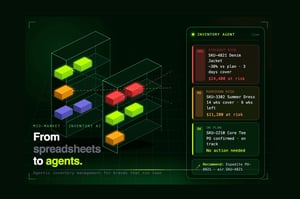
Agentic AI is everywhere in the conversation right now. But most of what's written is aimed at enterprises with large tech teams, big budgets, and years of digital transformation behind them.
That’s not the reality for most mid-market brands.
I’ve spent the better part of my career in the retail supply chain. Best Buy, Target, Gap, JCPenney, and close to a decade leading tech modernization at Walmart. But over the past year, my focus has shifted to mid-market brands and the practical application of AI in inventory management. And what I see consistently is this: CEOs are pushing their supply chain and merchandising leaders to “do something with AI,” while the teams themselves are running lean, stretched, and operating largely off spreadsheets and gut instinct.
So, let’s cut through the hype. Not with a technical roadmap, but with a clear picture of what agentic inventory management should deliver for a mid-market brand.
The Reality of Mid-Market Inventory Planning
Most mid-market brands run commerce platforms like Shopify and ERPs such as NetSuite. Demand and inventory planning? That’s usually a well-worn spreadsheet and a planner who knows the business inside out. Human intuition and pattern recognition are doing a lot of heavy lifting, and honestly, it works until it doesn’t.
The good news is that you don’t need to overhaul everything to benefit from agentic AI. But you do need to know what to look for, and what to expect from a platform before you commit.
CAPABILITY 1
Continuous Inventory Risk Monitoring
The first thing an agentic platform should do is what your best planner does every morning, only faster, more consistently, and across every SKU at once.
It should connect to the data you already have: inventory positions from your warehouse or ERP, open purchase orders, transfer orders, your demand forecast, and actual sales. From there it should be working continuously, not just when someone pulls a report. It should flag potential stockouts before they happen, catch overstock situations before they eat margin, and call out markdown risk when seasonal items aren’t moving fast enough. If your business deals with perishables or items with an expiry date, it should be catching those risks too.
“The result isn’t a scheduled report. It’s a live, prioritized view of what needs attention: your team’s morning briefing, ready without anyone having to build it.”
CAPABILITY 2
Dollar-Quantified Risk Prioritization
Flagging risks is just the start. What makes an agentic platform genuinely useful is the ability to put a dollar value on each one.
Not all inventory risks are equal. A stockout on a top-selling item during a promotion is a fundamentally different problem than carrying two extra weeks of a slow mover. A good platform understands this. It should calculate the dollar impact of each risk: lost revenue from stockouts, margin hit from markdowns, carrying cost from excess inventory. And it should rank those risks, so your team knows exactly where to focus first.
“When a platform can tell you, ‘This situation puts $24,000 of revenue at risk and here’s why,’ your planners can stop reacting to everything and start focusing on what actually matters.”
CAPABILITY 3
Reasoned Action Recommendations
This is where it gets genuinely useful.
An agentic platform shouldn’t just tell you what’s wrong. It should think about what to do about it. Should a purchase order be expedited to protect a high-visibility item? Is moving stock between locations the right call to rebalance? Is a markdown the best way to clear seasonal product before the window closes?
These are the judgment calls experienced planners make every week. A good platform surfaces those same recommendations, with the reasoning behind them, and puts them in front of the right person for review and approval. Your team stays in control. The manual work to get there drops significantly.
Where a Good Platform Takes You Next
Once the basics are working well, the scope naturally expands. The platform should be able to pull in external signals like competitor pricing, promotions, and market trends, and weigh those alongside your own data. It should be clear about when it can act on its own and when it needs a human to decide. And it should tell you when it doesn’t have enough information to make a confident call.
The more context it has, the more useful it becomes. And as that happens, your planners shift from putting out fires to focusing on decisions that require their judgment.
THE BOTTOM LINE
Mid-market brands don’t need to build this from scratch. What they need is a platform built for their reality: one that connects to the systems they already use, keeps a continuous eye on inventory risk, puts dollar values on the problems it finds, and helps their teams act faster and with more confidence.
This is exactly what we are solving for at Onepint.ai. An agentic inventory platform designed for mid-market brands, connecting to your existing commerce and ERP stack, monitoring risk continuously, and surfacing recommendations your team can act on.
If you’re a supply chain or merchandising leader being asked to do more with less, this is where to start.
In the next post, I’ll cover agentic scenario planning through simulations: how agents can model disruptions, test responses, and help teams make better decisions before committing a course of action. After that, we’ll get into agentic demand planning and what it truly means to move forecasting beyond the spreadsheet.