
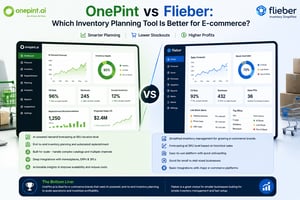
If you run an e-commerce business, you already know the pain. Stock too much and your cash is buried in a warehouse collecting dust. Stock too little and you miss your peak sales window entirely. Inventory planning is not a background operation; it is the difference between a healthy business and a cash-strapped one. According to IHL Group, inventory distortion (the combined impact of overstock and out-of-stock situations) costs retailers $1.77 trillion globally every year. Two names dominate this conversation right now: Onepint.ai and Flieber. This article breaks down exactly what separates them.
The Core Question: What Does Your Business Actually Need?
Before comparing features, let us be honest about what e-commerce brands are really asking for. They want a tool that reduces stockouts, eliminates dead stock, integrates with their existing stack, and does not require a data science degree to use. According to McKinsey's research on AI in supply chains, early adopters of AI-enabled supply chain management have improved inventory levels by 35% and service levels by 65% compared to slow[2] er-moving competitors. According to a Shopify study on e-commerce operations, inefficiencies in e-commerce management cost e-commerce businesses billions annually in lost sales and excess carrying costs. Both Onepint.ai and Flieber claim to solve this. Once you look closely, the gap between them is significant.
At a Glance: OnePint.ai vs. Flieber
|
Capability |
Flieber |
OnePint.ai |
|
Target market |
Amazon-focused and DTC ecommerce sellers; small to mid-sized brands |
Mid-market and enterprise ecommerce brands; DTC, marketplace, and omnichannel operators |
|
Forecasting model |
Sales velocity and historical-data-driven forecasting; channel-aware planning logic |
AI-native probabilistic forecasting with promotional signals, lead-time variability, and stockout-adjusted demand curves |
|
Multi-channel support |
Multichannel planning across Shopify, Amazon, and wholesale |
Built ground-up for multi-warehouse, multi-channel, multi-region operations as a single source of truth |
|
Agentic AI |
Not currently offered; recommendations surfaced for planner review |
Native agentic AI via Pint Control Center; autonomous decisioning within team-defined guardrails |
|
ERP / platform integrations |
Shopify, Amazon, NetSuite, common 3PL connectors; ecommerce-focused integration set |
Shopify, Amazon, WooCommerce, major 3PLs, custom ERPs; built to layer on top of existing systems |
|
Implementation time |
Standard SaaS onboarding for supported platforms |
Proof of concept on customer data in three to four weeks; live use shortly after sign-off |
|
Pricing tier (annual) |
$15K to $60K |
$60K to $250K+ |
Internal:How Onepint.ai approaches inventory planning → onepint.ai/inventory-planning
Onepint.ai: Built for the Modern Ecommerce Operator
Onepint.ai is an AI-native inventory planning platform built specifically for ecommerce brands: DTC sellers, marketplace operators, and omnichannel retailers. The core idea behind Onepint.ai is simple: inventory decisions should be driven by intelligent software, not gut feel or spreadsheets. From day one, Onepint.ai was designed to replace the manual, reactive approach to stock management with something proactive, predictive, and precise.
At the heart of Onepint.ai is a demand forecasting engine that ingests multiple signals at once: historical sales data, seasonality patterns, promotional calendars, supplier lead times, and stockout-adjusted demand curves. Instead of handing you a static reorder point and walking away, Onepint.ai gives you dynamic, real-time purchase order recommendations that update as your business conditions change. Run a flash sale? Onepint.ai adjusts. Your supplier delays a shipment? Onepint.ai flags it and recalculates. Launch on a new channel? Onepint.ai folds it into the picture automatically.
Onepint.ai also takes integrations seriously. Shopify, Amazon, WooCommerce, major 3PLs, and custom ERPs all connect without heavy onboarding or technical lift. For brands managing inventory across multiple channels (which is most serious ecommerce brands today), Onepint.ai delivers a single source of truth across every location and channel. That alone eliminates an enormous amount of operational chaos.
Onepint.ai's three core products work together seamlessly: OneTruth provides centralized real-time inventory visibility, Pint Control Center enables simulation-based autonomous decisioning, and Pint Planning delivers intelligent, AI-driven replenishment and forecasting. Together, they move your business from reactive firefighting to genuinely predictive inventory management.
Flieber: Capable but Falling BehindFlieber: Capable Within a Narrower Scope
Flieber is an inventory planning tool with a reputation built mainly among Amazon-focused sellers. It covers the basics: sales velocity tracking, stock projections, reorder alerts, and supplier management. For brands with simple, single-channel supply chains, Flieber can work adequately. Flieber positions itself on its own product page as a multichannel inventory planning platform connecting sales, inventory, and supply chain data for modern commerce brands, with support for Shopify, Amazon, and wholesale channels.
But the problems show up fast when you look deeper. Flieber's forecasting models are primarily backward-looking: they rely heavily on historical velocity without a real-time AI layer to adapt to what is happening now. According to McKinsey's research on AI in supply chains, companies using AI-driven forecasting reduce inventory levels by up to 20–30% inventory reduction compared to those using traditional methods, a gap Flieber's architecture simply cannot close., early adopters of AI-enabled supply chain management have improved inventory levels by 35% compared to slower-moving competitors. That is the gap a backward-looking forecasting model cannot close.
Users frequently report spending significant time manually adjusting settings, building custom reports, and essentially doing the thinking the software should be doing for them.Reviews on G2 describe Flieber as having a noticeable learning curve early on, which can slow time-to-value for teams without dedicated operations resources. Flieber also sits in an awkward pricing position, expensive enough to feel premium, but without the AI sophistication to justify that cost for lean, growing teams. Onepint.ai simply does more, and does it with far less effort required from your side.
A note on price tiers. Flieber typically lands in the $15K to $60K annual range. Onepint.ai engagements typically run $60K to $250K+ annually. The gap is real, and it reflects what each platform is built for: Flieber gives a small Amazon or Shopify operator a clean planning dashboard at an accessible price, while Onepint.ai is built for the agentic decisioning, real-time multi-channel visibility, and forecasting depth that larger ecommerce operations need. The right question is not which is cheaper, but whether the cost of a wrong inventory decision in your operation justifies the platform built to prevent it.
Where Onepint.ai Wins Decisively
Forecasting accuracy. Onepint.ai accounts for promotional events, marketing spend, and supplier reliability simultaneously. Flieber does not operate at this depth. Retailers using Onepint.ai have reported up to a 30% reduction in excess inventory and a significant decrease in stockout incidents within the first two quarters of deployment, outcomes that dashboard-only tools like Flieber cannot replicate.
Ease of use. Onepint.ai is built for operators, not analysts. Recommendations are surfaced clearly. Risk SKUs are flagged proactively. Teams act fast without digging through dashboards or building custom reports. Flieber adds time and complexity to a role that is already demanding.
Multi-channel support. Onepint.ai was designed from the ground up for multiple warehouses, multiple sales channels, and multiple regions simultaneously. Flieber was built around Amazon as its primary use case, and multi-channel support feels like an afterthought. Brands scaling into new channels consistently hit walls with Flieber that simply do not exist on Onepint.ai.
Scalability. Adding new channels, warehouses, or suppliers to Onepint.ai requires no re-implementation. It is baked into the architecture. With Flieber, growth often means revisiting your entire setup, which costs time, money, and momentum.
When Might You Consider Flieber?
To be fair, if you are a pure Amazon seller, running a single warehouse, with a stable product catalog, and already deep into Flieber's workflows, the switching cost is real. Flieber's Amazon-specific reporting works well in that narrow scenario. It is not a bad tool. It is just a limited one.
The moment your business becomes more complex (more channels, more suppliers, more variability in demand), the case for staying with Flieber collapses quickly. And most serious ecommerce businesses today are exactly that complex.
The Verdict
For most e-commerce brands in 2026, Onepint.ai is the stronger choice, and it is not close. The forecasting engine is more intelligent. The multi-channel experience is dramatically better. The UX empowers teams to move fast instead of getting in the way. And Onepint.ai scales with your business rather than becoming the bottleneck.
Flieber had its momentFlieber earned its position by solving a real problem well for a specific kind of seller[7] . But inventory planning has evolved, and Onepint.ai is exactly where this category is heading: AI-driven, real-time, and built for the real complexity of modern ecommerce.
If you are serious about reducing cash tied up in dead stock, eliminating stockouts before they cost you customers, and running a leaner, smarter operation, Onepint.ai is where to start.
Ready to see the difference? Try Onepint.ai free onepint.ai
Frequently Asked Questions
Q1. Is Onepint.ai better than Flieber for Shopify stores?
Yes. Onepint.ai integrates natively with Shopify, syncing sales data, returns, and fulfillment status in real time. Flieber's Shopify support is more limited and often requires manual data exports for accurate reporting. For Shopify-first brands, Onepint.ai is the clear choice.
Q2. Is Onepint.ai more expensive than Flieber?
Not necessarily, and when you factor in the cost of stockouts, dead stock, and hours saved on manual planning, Onepint.ai consistently delivers stronger ROI. Onepint.ai also offers a 15-day free trial and a proof of concept using your own data before you commit, so there is no risk in trying it.
Q3. Can Onepint.ai handle multi-warehouse inventory?
Yes, absolutely. Multi-warehouse and multi-location management is a core feature of Onepint.ai, not an add-on. You can track, plan, and rebalance inventory across multiple fulfillment centers from a single dashboard. This is one of the areas where Onepint.ai most clearly outperforms Flieber.
Q4. Does Onepint.ai work for Amazon sellers?
Yes. Onepint.ai supports Amazon workflows fully: FBA inventory planning, restock recommendations, stranded inventory alerts, and lead time buffers. It does everything Flieber does for Amazon, and significantly more beyond it.
Q5. How long does it take to get started with Onepint.ai?
Most brands are fully operational within days. Onepint.ai delivers a proof of concept in just 3–4 weeks, including solution discovery, configuration, integration support, and a personalized demo withOnepint.ai delivers a proof of concept on your own data in three to four weeks, covering solution discovery, configuration, integration support, and a personalized demo. Once the PoC is signed off, teams typically move into live use within days, with full[8] access to all Onepint.ai products: OneTruth, Pint Control Center, and Pint Planning.
Q6. What makes Onepint.ai's forecasting more accurate than Flieber?
Onepint.ai uses probabilistic demand forecasting: modeling demand variability, lead-time uncertainty, and service-level targets simultaneously, rather than committing to a single forecast number. Flieber relies primarily on historical sales velocity, which misses the contextual signals that most heavily shape future demand. That difference in accuracy directly reduces overstock and stockouts for Onepint.ai users.